Carnegie Mellon · User research · 2026
Before the First Mark: designing for the moment before someone starts
A healthcare company's innovation team needed to know where to invest in self-care. Advised by Francine Gemperle at Carnegie Mellon, I ran three rounds of research on creative self-care for adults with burnout. The question narrowed from "why don't people have time?" to "why don't people start, even when they do?" The answer is a moment no existing tool designs for, the one before the first mark. It produced four design principles, a product roadmap and a concept, Chirp.

The problem
A self-care bet without a user problem
The course brief put me on a healthcare company's innovation team. Leadership had picked self-care as their next big investment and needed research to say where. I narrowed it to journaling and drawing as self-care for adults aged 25 to 45 with burnout.
A scoping review of 42 studies found that art making lowers depression, anxiety and stress in adults. Yet most people who believe it would help aren't doing it. That gap between belief and behavior was the problem to explain.
What stops adults with burnout from using creative expression as self-care, and where could a product help?
Before fieldwork, I wrote 100 questions and grouped them into five themes that framed every round: permission and productivity, time and consistency, perfectionism and fear, social pressure, and mental health benefits. I also mapped who else has a stake, from therapists and wellness coaches to HR teams and stationery brands.
Round 1
The market solves the wrong moment
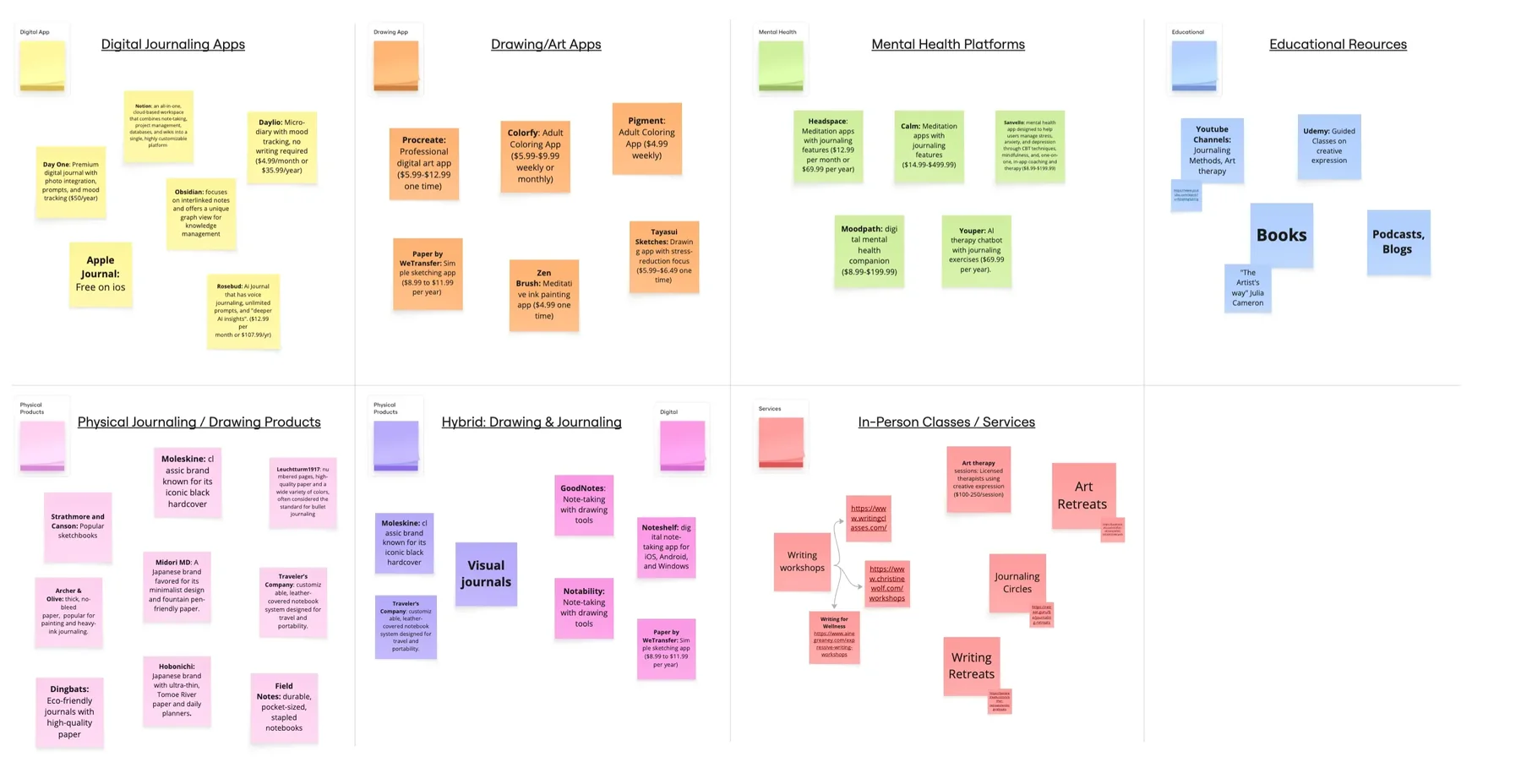
I audited more than 20 products across seven categories, from journaling and drawing apps to mental health platforms, paper notebooks and in-person workshops. Alongside that, I reviewed six sources, from a peer-reviewed review to first-person accounts of people trying to journal every day.
Tools are built for people who have already started
Most products borrow from productivity software: streaks, tracking and goals. They provide the canvas but nothing that gets someone onto it, and few allow for the way people drop a practice and come back to it later.
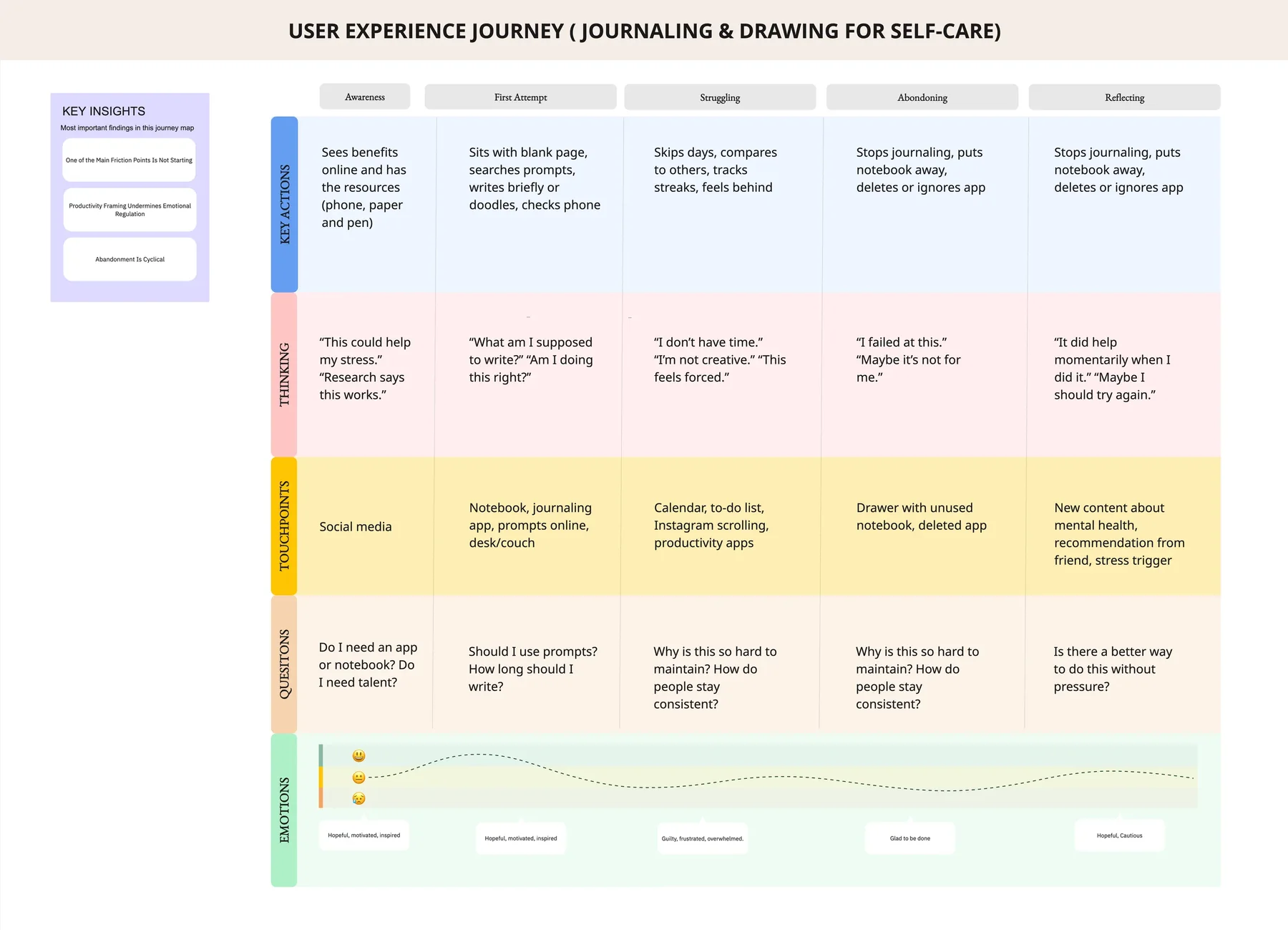
Adults stop being creative when it doesn't make money or feel productive, and wellness culture makes breaking a habit feel like failure.
Round 2
Even with time, people don't start
To test that hypothesis with people, I ran three methods side by side so each could check the others.
- Online observation: about four hours over six days on r/burnedout and r/journaling, reading without posting. I logged 15 threads in a spreadsheet and coded them against the five themes.
- Screener survey (Qualtrics): measured how common each barrier was and recruited interviewees in one step. I simplified dense answer sets after feedback before it went out.
- Interviews (6, 30–45 minutes): two in person and four over Zoom, recorded with consent. I chose participants to cover three user types the survey surfaced.
- Lapsed practitioners had a creative hobby before burnout and let it go.
- Aspirational beginners want to start but feel stuck at the first step.
- Quiet practicers already doodle or write in their notes app, but don't count it.
Time was the top barrier, but not by much
75% of respondents named time. A close second, 56%, said being inconsistent feels like failing. Most believed journaling or drawing would help with stress, and few had done either recently.
Perfectionism happens in private
I expected fear of judgment to be about sharing work. On r/journaling, a private and low-stakes space, people still worried about "ugly" pages and blank first pages. On r/burnedout, people described burnout like grief, for friendships, family time and a version of themselves.
I felt weirdly naked writing on the first page.
Post on r/journaling
Having time didn't mean starting
Even when people had time, they didn't start. One participant said skipping didn't feel like guilt so much as being "quietly disappointed." Another said it wasn't a big deal in the moment, but it built into background tension.
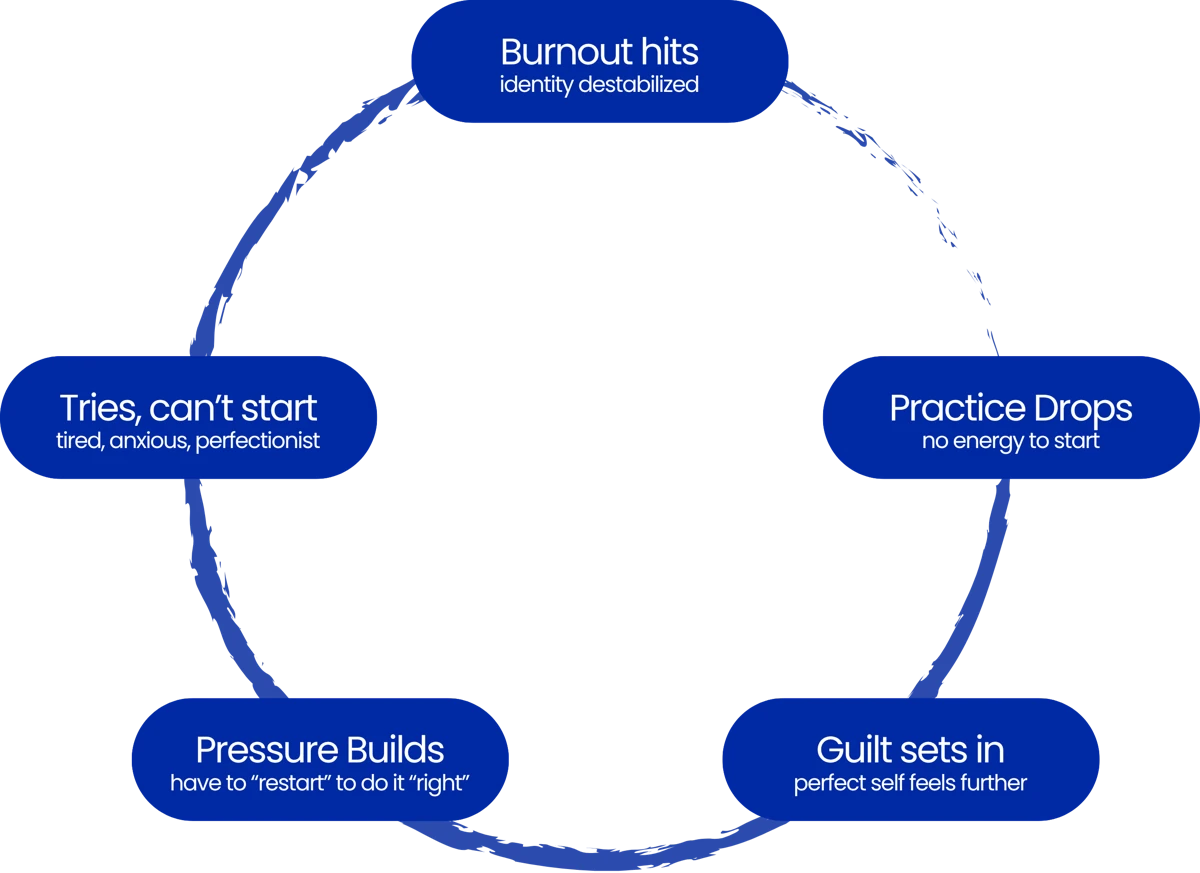
Seeing it as a cycle changed the question. People weren't lazy. Each failed restart made the next one harder.
People need permission to be inconsistent. If the activity itself asks for almost nothing, does the cycle open?
Round 3
Testing what happens when the ask is tiny
Guilt is fleeting and hard to describe after the fact, and interviews rely on recall. A diary study captured the experience close to when it happened. It also kept data collection low-pressure, which mattered: the method shouldn't add the pressure it was meant to study.
Three survey respondents enrolled for seven days, and two completed it. Each day brought one short creative prompt and two or three reflection questions, logged in a physical journal, then a 20-minute closing conversation. Each prompt came at the experience from a new angle: noticing, the inner critic, making something bad on purpose, and what counts. The guide told participants that five minutes counts, skipping counts too, and nothing has to be good or finished.
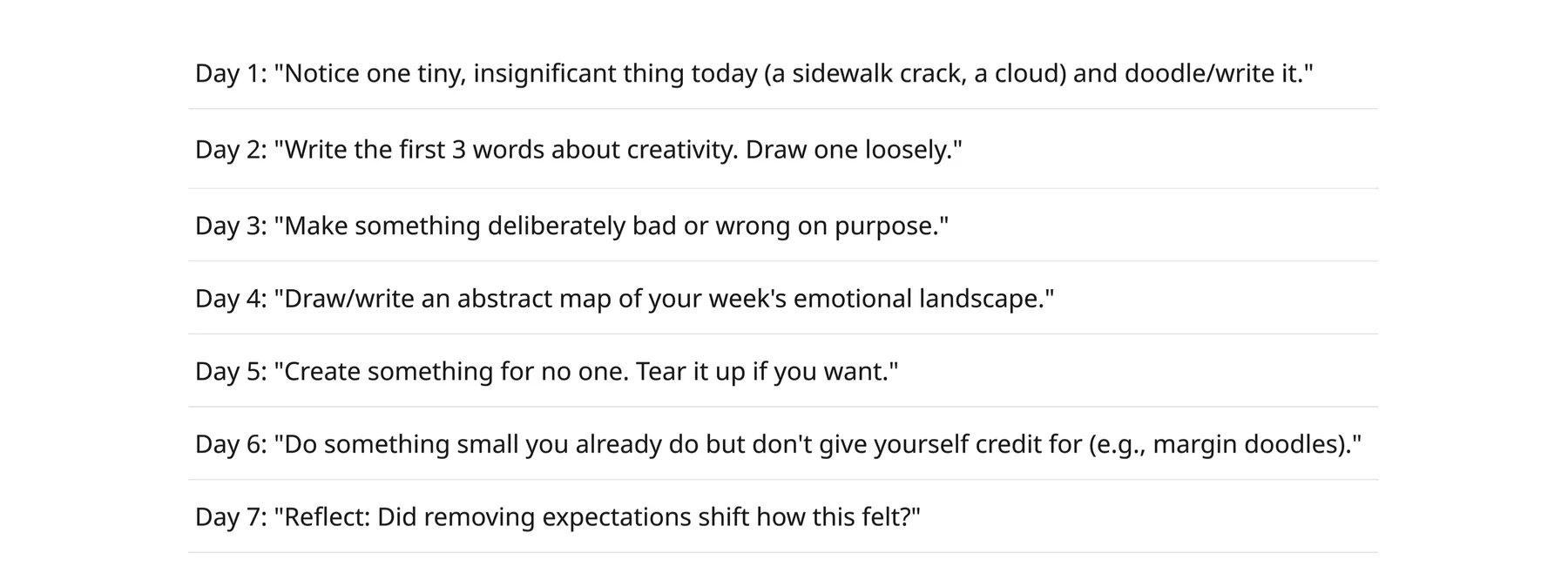
A specific prompt makes the first move
On day 1, one participant saw a sparrow on the way to their car and drew it before second-guessing it. Without the prompt, they said, they would only have thought about drawing it.
The prompt told me to notice something, so I already had permission. Otherwise I would have just thought about drawing it.
Diary participant, closing conversation
The physical object mattered
The same participant almost used their phone instead of buying a journal, and said afterward they probably wouldn't have engaged as much. The notebook made the practice something to pick up.
Skipping didn't bring guilt
One participant missed day 6 and was surprised it didn't bother them more. The other skipped a prompt they didn't understand and simply moved on.
Both participants engaged when something outside themselves made the first move: a specific prompt, a concrete thing to notice, an ask small enough that the inner critic had no time to weigh in. When that nudge was missing or unclear, they didn't start. That is a design problem, and a more solvable one than identity.
How might we design for the moment before the first mark, before the inner critic speaks up?
Synthesis
Who this is for, and where they drop off
I brought the three rounds together into one persona and a journey map, so the team could see the problem as one person's week instead of a list of findings.
Persona · composite of interview and diary participants
Jordan, 31, data analyst
Used to draw all the time. Still doodles in the margins of meeting notes, but doesn't count it. Has bought several journals in three years and finished none. Isn't trying to become an artist, only wants to feel less like they're holding everything in.
- Pain point
- The blank page carries weight, and missing one day feels like failing a streak.
- Behavior
- Engages when the ask is small and concrete enough to act on before talking themselves out of it.
- Needs
- Someone or something to tell them that what they already do counts.
| Awareness | First attempt | Struggling | Abandoning | Reflecting | |
|---|---|---|---|---|---|
| Doing | Sees a wellness post, gets a daily prompt that says "notice something," buys a new journal. | Draws a coffee cup before second-guessing it. | Reads a prompt, doesn't get it, closes the notebook. "Later" never comes. | Skips a full day. Doesn't try to make up for it. | Looks back at the week. Realizes the doodles in meeting notes are the same thing. |
| Thinking | "The prompt gave me a reason." | "Is this what I'm supposed to be doing?" | "I'm too tired, it won't be good anyway." | "Hm, I thought that would bother me more." | "Wait, I doodle in every meeting. Is that the same thing?" |
| Feeling | Curious | Surprised | Confused | Disappointed | Hopeful |
| Opportunity | Give a reason to start that is specific enough to act on before second-guessing begins. | Make the prompt concrete enough that the first mark happens before doubt does. | Offer a version that asks almost nothing: one word, one line. | Treat the skip as normal. The next prompt is a fresh start, not a makeup assignment. | Build in the reframe: ask what they made today, including the small stuff. |
Impact
From findings to a roadmap
The reframe changed what a product should optimize for. Instead of keeping people on a streak, it should make starting easy and let them stop without penalty. I turned that into four principles:
- Let the prompt make the first move. A specific ask, like "Draw what you see right now," removes the decision to begin.
- Treat a skip as normal. No streaks or progress bars, so coming back never feels like catching up.
- Count what people already do. Margin doodles and notes-app rambles are the practice, and the product should say so.
- Keep it off the phone. A physical object made the practice feel separate from everything else on the screen.
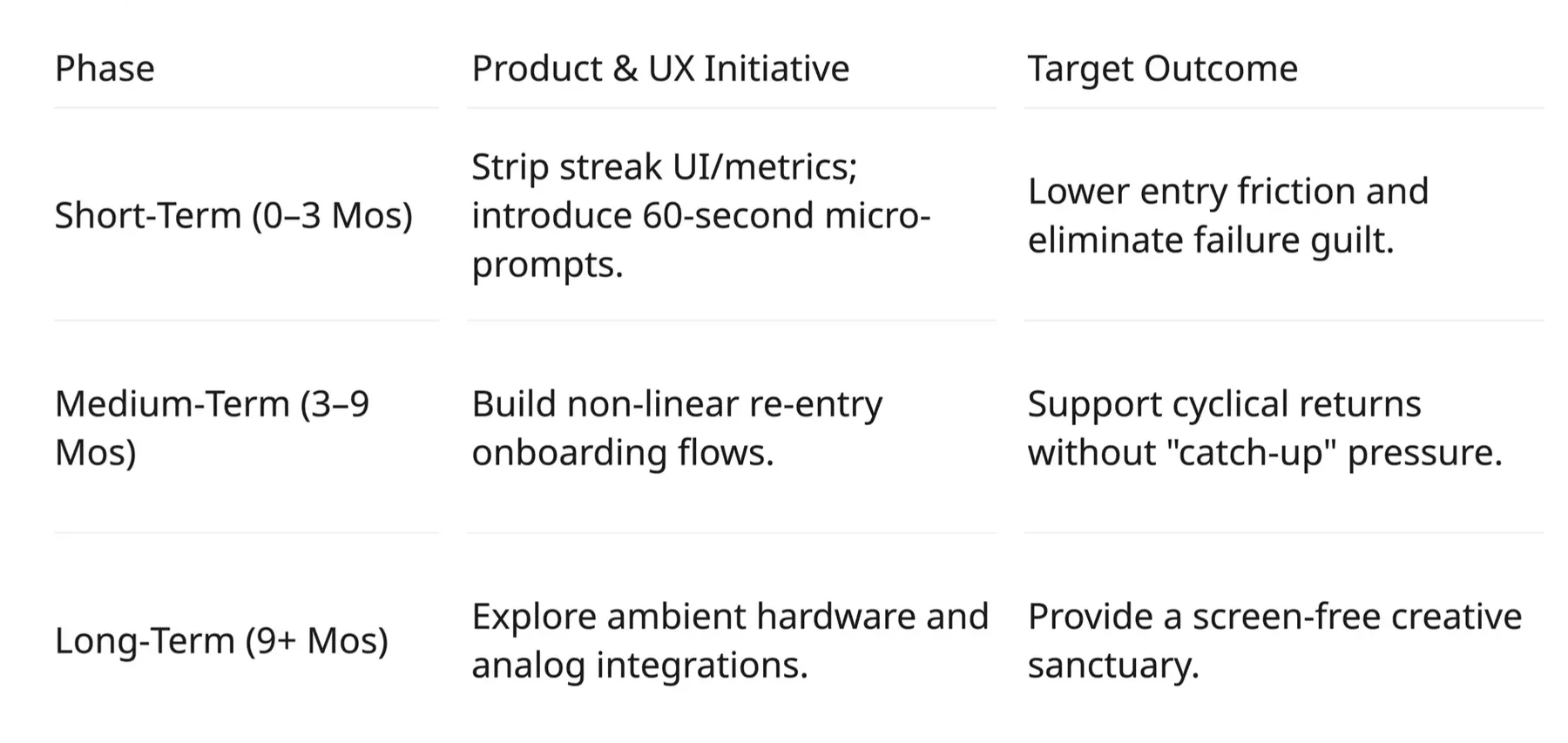
For the innovation team, the roadmap starts with changes any existing app could ship: strip streaks and add 60-second prompts. It ends with the longer bet the research points to, a screen-free tool. To show what that could look like, I designed Chirp: an e-ink keychain shows one 30-second prompt a day, a pen and reusable notebook capture what you make, and the app keeps it with no streaks and no notifications.
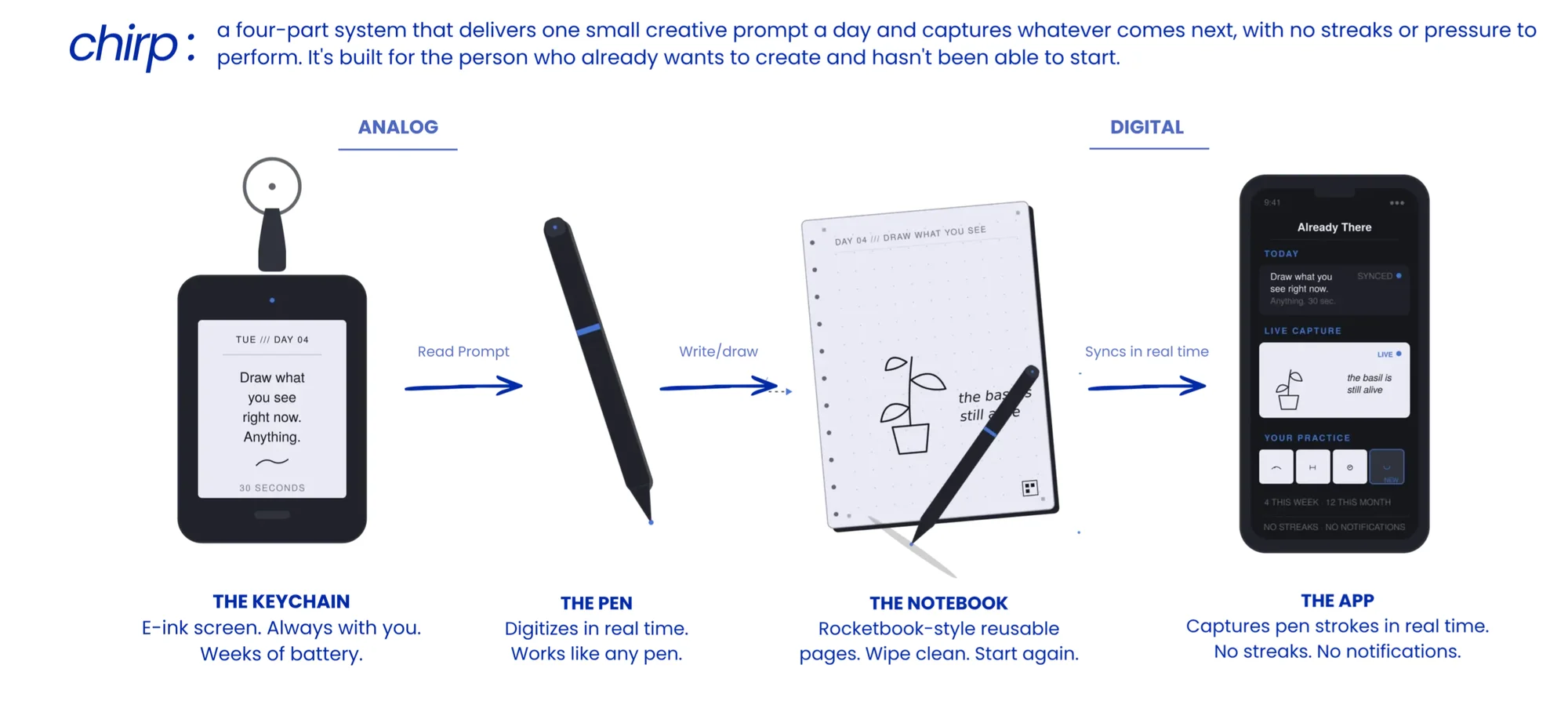
How I'd measure success: how often people return after a gap and how they feel right after a session, rather than daily active users or time in the app.
Key decisions
- 01
Follow the question, not the brief's first framing
The brief was about where to invest in self-care, and time was the barrier most survey respondents named. Designing for time would have been a clean answer. But in interviews, people who had time still didn't start, so I moved the study to the moment before starting. That cost me the tidy answer the brief seemed to expect, and it's why the roadmap points somewhere no existing tool covers.
- 02
Use a diary study for Round 3
More interviews would have been faster to run and easier to recruit for. But guilt is fleeting, and interviews rely on memory. A diary caught it close to when it happened. The trade-off was a small sample: three enrolled and two finished. I kept it low-pressure so the method wouldn't add the pressure it was studying, and I say plainly that the findings are signals to test.
- 03
Measure returns, not streaks
Daily active users and streaks are what a team would normally report, and they're easy to measure. They would also reward the pressure the research found harmful. I proposed tracking how often people come back after a gap and how they feel right after a session. Those are harder to collect, and they measure what the research says matters.
Reflection
What I learned
The deliverable was a better question
I expected the barriers to be external and the guilt to be social. Both turned out to be internal, and that reframe is what made the problem something a product could address.
Limits and next step
Two participants completed the diary study, so the physical-object finding is a signal to test. Next: a longer diary study across all three user types, with and without streaks.